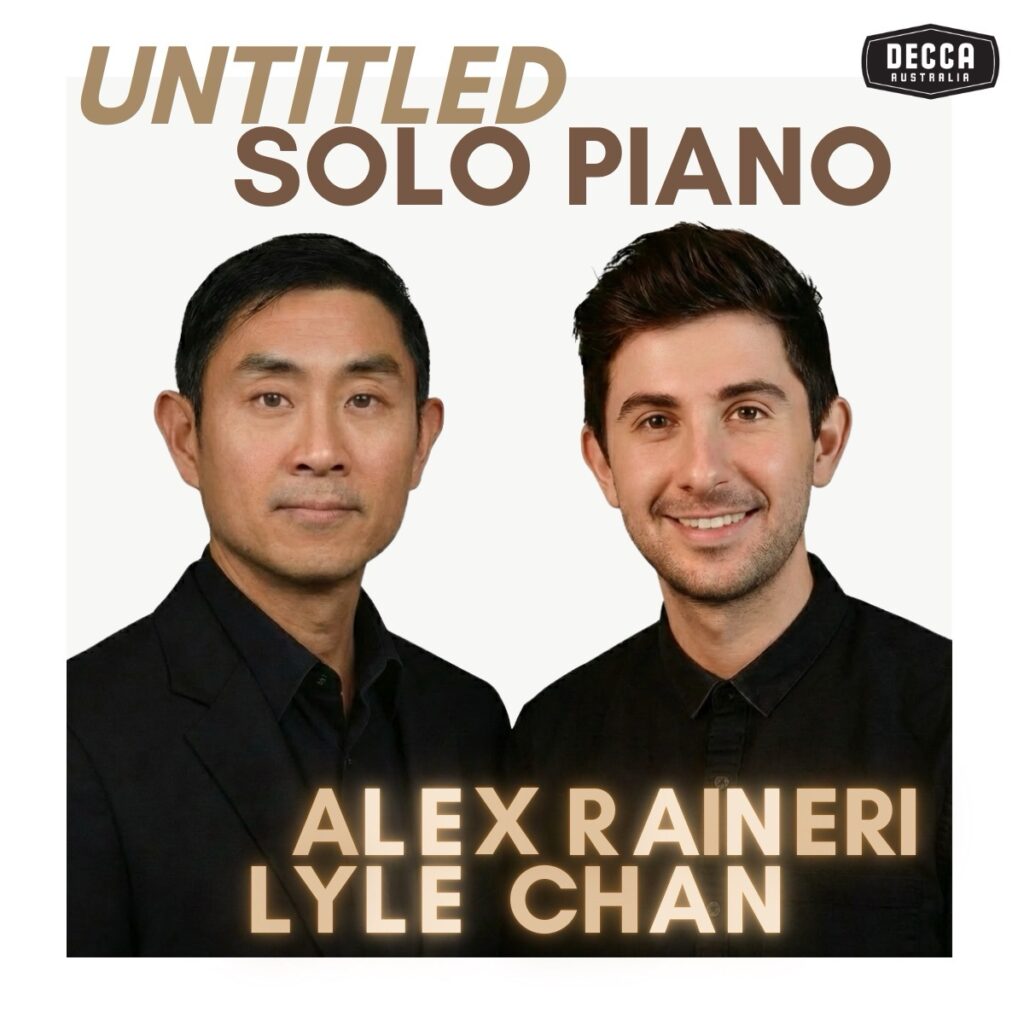
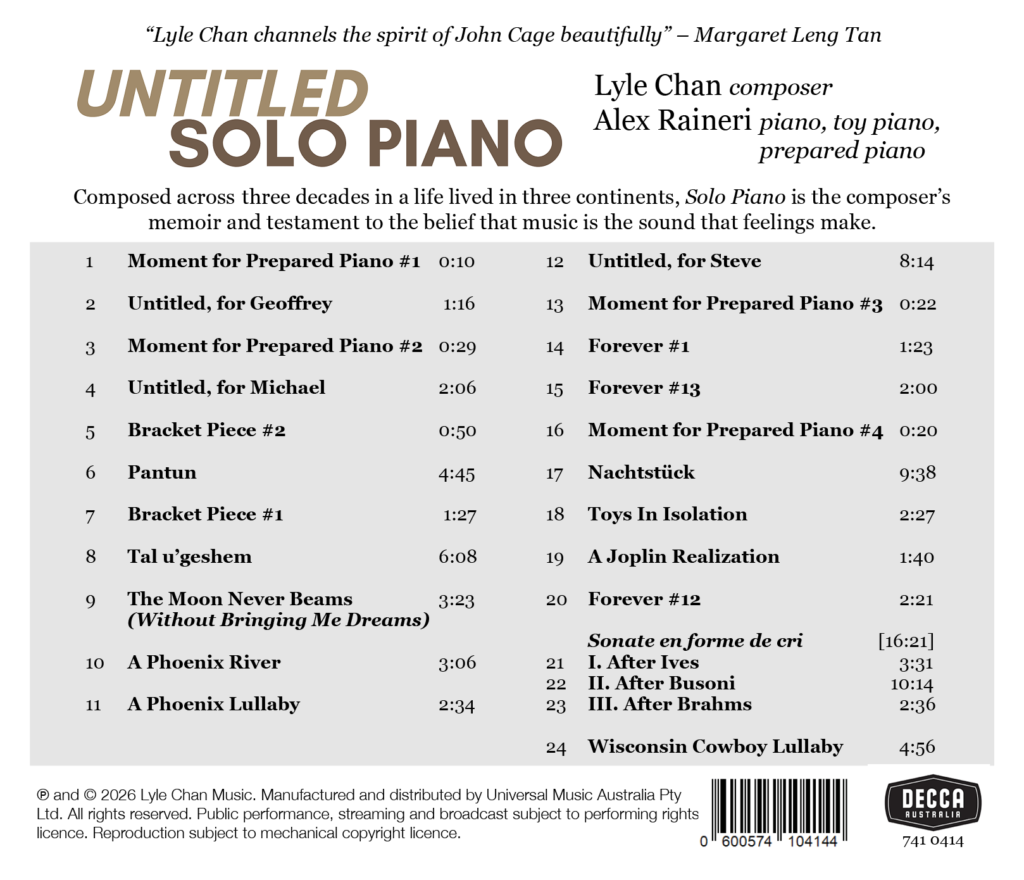
The following is a longer version of the program notes for Untitled: Solo Piano, a recording of my work Solo Piano performed by Alex Raineri and released by Decca in June 2026. The album booklet contains a short version edited for reasons of space.
To listen by Streaming or Buy the Compact Disc
Full album – Untitled: SoloPiano
My music is like a diary. At least, it’s the part that cannot be said in words, whereas the part that can be will be.
Some composers are like novelists, while some others are short story writers, or journalists. I suppose I’m a memoirist. My musical sketches are a diary first, the completed music the memoir. I unknowingly fell into this habit during the AIDS epidemic, when there was no time to compose, only time to sketch. During those years, music became my way of writing down feelings, proving time and again that music is the sound that feelings make.
It only gradually dawned on me that I was only meant to write one piece in any one genre. There will only ever be one string quartet, one solo piano piece, one orchestral work, one music drama. I found that as I was writing any piece, I couldn’t end it. When I ended a piece, it felt like the ending of a section, not of a work. So I eventually gave in, and embraced this idea of perpetual works-in-progress.
The two oldest of these works are Solo Piano and String Quartet. Solo Piano is a single composition that, in its entirety, lasts nearly 3 hours so far as I can tell. I began this composition when I was about 17 years old. I have confided in the piano, my instrument, documenting my feelings through cycles of losing and finding myself.
Every time I write music, it is a journey into the unknown. It’s been said that the quality of your life depends on the quality of the questions you ask. The quality of the music depends on the quality of the questions the composer asks. I don’t write by formula and my music has very little repetition. If you ever hear a passage that resembles another, it’s because I asked the same question sensing I’d get a different answer.
I think back on my fortunate life lived across disparate countries. I was born in a remote part of Malaysia but through my parents’ devotion I got to migrate to North America, and then Australia, which has now been my home for more than half my life.
I tell about how it wasn’t until I lived in Madison, Wisconsin that I came out as a gay teenager. My first boyfriend Geoffrey, the son of the composer Robert Wright, was the source of my strength. Geoffrey was HIV positive. As Geoffrey got sick, I became a full time AIDS activist. I was radicalized, at a time when the word could mean something good. After I moved to Sydney, I ran a ‘buyers club’ for people with HIV and AIDS – one brave man in Los Angeles helped me get underground drug treatments that were not available in Australia. The activism stories were mostly told in my string quartet memoir excerpts released 10 years ago.
I wouldn’t say my life is so interesting that you would want to – literally – hear about it, and yet there is no such thing as a life without something interesting in it. Everyday I observe people around me and I repeatedly come to this conclusion. There are only two ways to live your life, as the saying goes,. One is as though there is no such thing as a miracle. The other is as though everything is.
Preface to the score
Solo Piano is an open-form work to be realized anew for each performance. It is a collection of modules to which the composer may add at any time. The modules may be played in any order; each may be played in its entirety, or omitted in its entirety, or a portion of it played. Any moment may be played with surface preparation on the piano strings. Any moment may be repeated with or without surface preparation. What is not specified is not specified.
This 2025 actualization is made by Alex Raineri and the composer.
Moments for Prepared Piano (Tracks 1, 3, 13, 16)
My journey to John Cage started indirectly when I was asked to play in a performance of The Banshee by Henry Cowell. This aptly titled eerie work led me to the prepared piano, which of course led me to John Cage.
I missed my chance to meet John Cage. He came to Madison less than four months after I left, to hear a new (but as it turns out, his final) piano work (One5) written for his old friend, the pianist Elsworth Snyder who ran a new music series in a stunning Frank Lloyd Wright building. Cage died the following year.
Catalyzed by Buddhism, Cage did away with the composer’s ego. Where other composers used their taste and judgement to create music, Cage created music by leaving things literally up to chance. He erased the ego by letting dice, Tarot cards and I Ching prophecies make the compositional decisions.
I had a very different take, but I felt an affinity with Cage’s nonegoic philosophy. Where other composers sought to create a recognizable signature style, I had no such interest. Instead, I created music by allowing in any style that I encountered, by chance or design. To me, it all belonged together. There is no such thing as incoherence. Partly, I found myself participating in the postmodernist movement that emphasized democracy rather than hierarchy across styles, so that serialism and ragtime, for instance, were co-equals in cultural value. But also partly, I found myself emerging from Buddhism.
In Malaysia my family observed traditions that were Buddhist fused with Confucian and Daoist practices. Discovering Cage’s Buddhism reinforced my belief that everything is one and belongs together, and the ills of the world come from falsehoods that anything needs to be kept apart from anything else. Whether it’s one human race argued as needing to be insulated from another, or a high culture that must be preserved from barbaric contamination. This is Buddhism’s core tenet of nonduality. Self and other, good and evil, animate and inanimate, these distinctions are illusions along the human journey to a realization that everything is connected. It takes active separation to keep things apart. At the beginning of the journey, the ego wants to preserve itself, distinct from everyone else. But at the end of the journey, there is no ego; it is erased, dissolved into the whole and one.
Untitled, for Geoffrey (Track 2)
This music was a gift for my first boyfriend, Geoffrey. I met him in a gay bar in Madison. Geoffrey was nine years older, had a hint of an English accent (he was born there but grew up in the US), made bagels for a living (well, as foreman of a popular bakery) and was drily flirtatious. When we started dating, he told me he was HIV-positive. After I showed interest in a serious relationship, he started putting some distance between us, like waiting a few days before returning my phone calls. It was 1989. Geoffrey was HIV-positive in a world where he would inevitably get AIDS and die. Pulling away was how he protected me, because you couldn’t lose something you never had in the first place. I was angry at him for it, but he changed the course of my life. Before Geoffrey, AIDS was theoretical to me. After Geoffrey, I saw it everywhere, as if I had been slapped awake.
Geoffrey loved music. He was the son (technically stepson) of Robert Wright; a certain pressure from knowing that his father, along with George Forrest, formed the songwriting duo responsible for Broadway hits like Kismet and Song of Norway conjured one of the most beautiful melodies I’ve ever had the privilege to be visited by. The day I gave Geoffrey the music was the only time I saw him let his guard down and his eyes soften and water. I could see plainly what he was thinking: if only it didn’t have to be this way.
Bracket Piece #2 (Track 5) and Bracket Piece #1 (Track 7)
In these, I combined two things John Cage was known for but never used together: the prepared piano and the time bracket.
In 1988, Cage was using time brackets to compose but it had been more than 30 years since he stopped using the prepared piano; here I was just discovering it. And I betrayed the time brackets by omitting time: where Cage specified a bounded duration, anytime during which the player may play some indicated material, I simply indicate material and leave it to the player to choose when to play it.
‘Bracket Piece #1’ uses unfixed surface preparations: objects like table tennis balls, aluminum foil and small tubular bells (chimes) are placed on the strings that move freely during the performance, whipped up by the vibrating strings.
Revealing its origins in the winters of Wisconsin, ‘Bracket Piece #2’ originally specified an ice scraper sliding along the strings while keyboard clusters are struck, resulting in dovetailing harmonics. As this was recorded in snowless Sydney, Alex Raineri had the idea to replace the scraper with a guitar slide, and I wholly approved.
I wrote these Bracket Pieces purely out of love of sounds – their color, their velocity, their penetration. I wrote these as art for art’s sake. Maybe that makes them misfits in a memoir, as if someone’s diary suddenly had abstract poetry and experiments in neologisms and wordplay.
In a way, music for sound’s sake is what I write for myself while music of the harmonic series is for friends. I have said elsewhere that music is the sound that feelings make. All types, including both these types, of music convey feeling, whether we know now or discover later what they are.
Untitled, for Michael (Track 4)
I was close to two Michaels. Both were HIV positive. The first lived in Madison. I met him before I met Geoffrey, in 1986, and though Michael and I dated, we weren’t boyfriends. We were friends for three years before he moved to Washington DC to work as a local government analyst, even though he was a superb classical organist by training. On our first date, he chided me for not knowing Schubert’s String Quintet (“you should if you’re serious about music”). In 1994 when he got very sick with AIDS, Michael moved home to Wisconsin, and a few weeks later he died, so young that he was outlived by his whole loving family – his mom, dad, and 5 brothers and sisters.
The second Michael was a boyfriend of mine in Sydney. I met him the year the first Michael died. He loved the outdoors, gardening, swimming and was healthy enough when the miraculous protease inhibitors arrived that he thrived on the life-saving drugs. But this first generation of protease inhibitors had a side effect called lipodystrophy, which makes the fat in the body take abnormal shapes. Michael became self-conscious of how his face was changing, a sensitivity understandable for someone accustomed to being a very handsome man in urban gay culture. And he explained that he couldn’t be loved, and that we had to break up.
I wrote this unabashedly sweet music thinking of Michael in Sydney. I had also sketched music for Michael in Madison, but it was more complex and till this day I haven’t put it into performable shape. I feel guilty for not having finished that music. For no reason other than that I often, inexplicably, think of them together, they who never met, this music does double duty for now. Maybe that’s why there’s a repeat symbol in it and I want it played twice.
Pantun (Track 6)
My father worked at a remote tin mine in Selangor, Malaysia, so our family lived there. When I was 11, on a visit to the big city, I heard a boy play ‘The Lone Ranger’ theme, i.e. Rossini’s William Tell Overture, on the piano. I was amazed it was possible to play TV music like that. So I asked for piano lessons. Being the 1970s in a rural Malaysia, there was no Western classical music – none on the radio, no concerts, and my home did not have a record player. But my parents found someone to teach me piano, and I learned to read and play rudimentary music. Then someone gave me some classical sheet music. The first time I ever heard Bach and Mozart was when I played it myself. I had no idea of nuance, let alone interpretation. I saw the notes on a page and I played the notes on the piano. I did not realize how unusual this was until I began the next phase of my life in North America. Till this day I haven’t met anyone else whose first experience of Bach and Mozart was playing it themselves.
When Alex Raineri asked me write a work drawn from my heritage, whatever I construe that to be, it was the first time anyone asked me to, and the first time I wanted to. Born in an Islamic country to British subjects, I find it hard for any talk of heritage to evade the topic of colonization. Colonization made me acquainted with things both European and Malay. When I hear a work like Ravel’s ‘Pantoum’, I’m reminded that I know both pantoum and pantun – French works of poetry or music by the likes of Baudelaire and Ravel, and the traditional Malay fixed form poem that served as their inspiration. I recall the childhood fun of watching my clever friends compete with each other inventing new pantuns in front of audiences. A pantun has a rigorous structure in which a person must invent new lines but also interpolate lines the previous person spoke. My Pantun could be seen as an act of reverse colonization, imagining Ravel’s music upside down and back to front, reversed by me as a thirdworld-born firstworlder reminding Western/French art of its Eastern/Malay origins. Pantun begins with a nursery rhyme and then a child suddenly grows up, very fast.
Tal u’geshem (Track 8)
I’ve known my friend Phillip since my first year in Australia. This music began as a gift to him, following a trip we made to the Sydney Jewish Museum where Phillip wanted to trace his ancestors from Poland. There we met Eddie Jaku, survivor of four Holocaust concentration camps.
A magnetic raconteur, he told the most harrowing stories but with a lightness that made you want to hear deeply, rather than recoil. How he escaped the first attempt to send him to Auschwitz by prying open the floorboards of the train. How his father saved lives by rationing one bucket of drinking water amongst overcrowded prisoners. How they survived the bitter winter by sleeping in huddles, but rotating positions through the night so whoever was on the edge wasn’t frozen dead by morning. Despite it all, he called himself the happiest man in the world.
His happiness infuses the middle section of this music. It’s the only part played by both hands. The section before is for left hand alone, the section after for right hand alone. I thought of Siegfried Rapp, the German pianist whose right arm was destroyed by shrapnel in World War II; he played left-hand repertoire, like Otakar Hollmann and Paul Wittgenstein when their World War I injuries made them one handed-pianists.
I didn’t conceive them this way, but I now think of Pantun and Tal u’geshem as foils for one another. When I was living in Malaysia, I had Muslim friends and learned to write the Malay language in Arabic script. When I moved to the US I had Jewish friends and I wore a yarmulke in the synagogue while playing piano to accompany my friend Richard singing Ashkenazi tunes and Ravel’s Kaddisch.
The Moon Never Beams (Without Bringing Me Dreams) (Track 9)
A highlight of being a record producer for the Australian Broadcasting Corporation (which I was for over a decade) was going to the Sydney International Piano Competition with my friend Cyrus. His is a vast, instantly recalled knowledge of pianists and piano repertoire like nothing I’ve ever encountered. Cyrus and I were like the de facto ‘second jury’ in that the formal jury awarded the prizes, but we independently chose which performances to issue on compact disc. The verdicts often did not coincide. In 2000, the Competition officials were miffed when we devoted an entire CD to a Texan pianist eliminated after Round 1.
I also heard Evgeny Ukhanov, a Ukrainian pianist recently come to Australia, give a spellbinding performance of Scarlatti’s D minor piano sonata. I was struck by it being wholly slow music, containing no virtuosity whatsoever, antithetical to the flashy Scarlatti usually chosen to impress a jury. I didn’t even know Scarlatti wrote tender music like this. As I listened, my imagination offset the music against crystalline Feldmanesque structures. I didn’t know why the idea seemed right, until I learned later that Scarlatti also wrote dissonant tone-clusters into his sonatas.
The title doesn’t mean anything, except I did see the moon beaming intermittently amid clouds as I completed this while in Rotorua, New Zealand. I was reminded of an Edgar Allan Poe poem in which a man, mourning the woman he loves, sleeps every night by her tomb near the sea, still seeing her eyes in the stars, dreaming of her every time the moon shines.
A Phoenix River and A Phoenix Lullaby (Tracks 10 and 11)
Phoenix was written for pianist Andrew Rumsey, who saved his parents’ home by continuously dousing it with water during the 2019-2020 Australian bushfires. The Australian landscape actually depends on fire to regenerate, but on its terms, not the uncontrolled fire caused by human disregard for how the land inherently wants to work. The 19 million hectares burned were a turning point in Australian attitude to climate change. The country was experiencing what philosopher Glenn Albrecht calls “solastalgia”, the homesickness felt even though you haven’t left home, but home has altered.
Water and sleep rejuvenate. In the two excerpts from Phoenix recorded here, the first is a fleuve, the second a lullaby. If there is a Beethovenian touch to them, it’s because the world was meant to commemorate his 250th birthday in 2020, yet another thing scuttled by Covid-19.
Untitled, for Steve (Track 12)
This music is so many things, it’s hard to say.
Beauty is a very intense thing to experience. It makes me feel vulnerable. And to receive beauty, I have to unshield my senses, leave them wide open, so that anything at all, from ecstasy to hurt, can touch them. I think this is why people cry when they experience great beauty, because they suddenly know how good it feels to be touched. The state of perceiving beauty can feel perilous, but there’s no other way to perceive beauty.
As an artist, the greatest courage of all is to say what’s on your mind. In my case, it’s writing what I want to hear myself say, not what I think others want me to write or say. The greatest courage is honesty, which leads to authenticity, which leads to beauty.
Amongst the many things it is, this music is a gift to Steve Pavlina, the teacher and philosopher who helped me understand courage. When I sent him an earlier version, he replied that it was beautiful but he could still hear me searching. And he was right. So I revised it to its present form.
I’ve learned that courage and fear could – and should – peacefully coexist. For as long as the spiritual beings that we are are having a human experience, anyway. Not only is it fine for both to be present, but because growth only happens at the edge of your comfort zone, truly new experiences only happen at the interplay of the two. All my life I mistakenly assumed that courageous people feel no fear. I learned instead that fear is the true compass showing you where you have surrendered power that’s left for you to reclaim.
What I know now that I didn’t know then was that I was a little afraid of how beautiful I could make music be. I was embarrassed by the beauty in my music, and I would ‘tone it down’ before presenting it to people. Does this sound strange? It should. Yet as Marianne Williamson wrote, “It is our light, not our darkness that most frightens us…. Playing small does not serve the world. There is nothing enlightened about shrinking so that other people won’t feel insecure around you.” I was afraid that the beauty I could express would make others feel unsafe. And I was afraid of how people would react when feeling unsafe, that they could misunderstand the beauty and mistake it for a calculated effect, like a cheap trick to tug on the heartstrings. But when someone is completely authentic, the result is the purest beauty. It’s something to strive for, constantly.
Forever #1 (Track 14), Forever #13 (Track 15)
On September 11, 2001 I was in Melbourne. Soprano Yvonne Kenny, conductor Guy Noble, the Melbourne Symphony Orchestra and I (as a producer) were recording songs from Broadway musicals. After dinner I stayed up late to watch The West Wing, then my favorite television show. It started at 10.30 pm. During a commercial break I went to brush my teeth, only to come back to a live CNN report of an aeroplane having flown into 1 World Trade Center. Initially I thought I was watching the most realistic West Wing episode ever. Then an aeroplane flew into 2 World Trade Center. It was 11.03 pm in eastern Australia, 9.03 am in the eastern United States. My phone started ringing and filling up with text messages.
No irony was lost on any of us the next morning. Our recording project was of the great Broadway tradition of New York, the very city now gripped by mass confusion. We didn’t say much beyond soothing platitudes to each other. We went about our jobs, because you can still do that when you’re numb.
9/11 aroused in me a strange homesickness. A few months later in May 2002 I went to Madison and then New York. In Madison I sought out old friends who hadn’t left and old places which hadn’t changed. I went back to my old church where the caretaker Bob greeted me with genuine delight and as if the intervening 12 years were 12 months, offering to unlock the basement for me so I could play my old upright piano where it still stood in the practice room. I sat on the shore of Lake Mendota and ate a taco salad with a flaky pastry shell; I went to the dairy store where I used to work and ate cheese curds for old times’ sake, because that’s what used to be my lunch. I bought used paperbacks at Avol’s Bookstore, whose slogan – “I’d Rather Be Reading Bukowski” – hasn’t changed to this day and still makes me laugh. And I had a drink at a bar called The Shamrock where there used to be a young bartender who took a shine to me and let me do my college homework at the booth tables while he brought me liquor.
In New York in May 2002 at Ground Zero I saw makeshift memorials with photos and messages, especially on the walls of the ramp leading up to the official viewing platform; some of these used to be appeals for information about the missing, but which defaulted into memorials when hope faded. From the platform I saw an assortment of rubble on dirt being tackled by cranes, earth-movers, grapplers, bucket loaders. It was disorienting. I had no idea what I was looking at. Later I learned that Laura Kurgan, an architect, had voluntarily drawn up a map of the disaster zone and given copies away to visitors so they could at least make head or tail if not sense out of what they saw. On the evening of May 28, 2002 workers cut down and cleared away the last debris, a 36-foot corner beam from 2 World Trade Center that had stayed standing after the rest of the building collapsed. I didn’t know I’d be there that day. Column 1001-B, as it’s called, now stands in Foundation Hall of the National 9/11 Memorial Museum.
I constructed Forever #1, written on the second anniversary of 9/11, to last a minute, akin to the silence observed at a public grieving. Forever #13 was written for the 4th anniversary, is twice as long, no longer a grieving but a goodbye to things past.
Forever #12 (Track 16)
This music is actually a postlude to Untitled, for Geoffrey. I only called it Forever #12 years later. After Geoffrey became deliberately cool, I angrily broke things off, even though he was the one who’d decided already. At the time I was studying Beethoven and molecular biology. I think I was just lonely. Feeling helpless about AIDS, I got a job sequencing HIV genomic RNA in a retrovirology laboratory. All the forevers are just little moments that try to touch infinity so that something lingers when we, little human creatures, are gone.
Nachtstück (Track 17)
I wrote Nachtstück in memory of a friendship. I met Tom at a Roman Catholic church in Madison where he was the organist and I the pianist. We discovered we were both studying for physics degrees, he for his Master’s and I for my Bachelor’s.
In spring of 1987 I needed a place to stay, and Tom invited me to live with him. One night, I found I couldn’t understand anything Tom was saying. He was sitting up in bed, talking in perfectly articulated words, yet making no sense. This was how I discovered Tom had bipolar disorder. He was having a hypomanic episode.
I learned to respect Tom for the times when he wouldn’t take his medication. I knew it made him unable to have feelings properly. The ‘even keel’ that the lithium, anticonvulsants and other drugs gave him also made it impossible for him to truly experience emotions. Without the drugs, he was prone to disruptive antisocial behavior, but he was clearly more his natural self, his humanity intact if frightening for other people. The medication was for society’s sake rather than Tom’s.
I built Nachtstück on the Nachtstücke of Schumann, pieces that he would have called ‘Corpse Fantasy’ had it not been for the counsel of his wife Clara. If the listener doesn’t know the suppressed individual titles (Funeral Procession, Strange Company, and so on), these would be heard as beguiling, dramatic and indeed uplifting pieces of music. I wish the same for my Nachtstück – that knowing the story of Tom doesn’t mean this isn’t also a music of joy and thanksgiving. I shouldn’t have been surprised to find the unmistakable essence of Bach seeping through. Tom, like all organists, loved Bach, and many nights after choir rehearsal, he and I would stay back and in that church he’d play me my first hearings of so much of Bach’s organ music.
Toys In Isolation (Track 18)
Having never met John Cage, my being friends with Margaret Leng Tan was the next best thing. I once said as much to her and she responded, “you channel John’s spirit so beautifully” which rendered me speechless; with Cage, silence is always appropriate. Margaret was about to make her Sydney Opera House debut in March 2020 when the concert became one of the country’s very first to be canceled due to COVID-19. We had had dinner scheduled for the day she landed, but she never made it and instead stayed in New York. So that evening, instead of our “chat and chew” as we called it, I wrote her this piece, incorporating two of her specialties: toy piano and prepared piano. It was adapted from music I’d written to commemorate the centenary of 1918, the year in which two things ended and one began: the first world war, the short life of Debussy, and the so-called Spanish flu, which was the last time the world stopped for a pandemic.
A Joplin Realization (Track 19)
Donna Coleman and I hit it off as soon as we met because of our shared passion of Charles Ives. She played the Concord Sonata at the 1996 Sydney Spring Festival of New Music when I was artistic advisor to its founder, pianist Roger Woodward. And she re-acquainted me with ragtime, the same way a historically-informed performer re-opens someone’s ears to Mozart. I learned ragtime has as much un-notated nuance in its performance practice as Baroque music.
I bought Peter Gammond’s book on Joplin and saw in it the photo of the upright piano he owned (or at least used). On it was a manuscript with legible music, a fragment of an unknown work, possibly never finished or the remainder lost.
Just about all the unpublished work Joplin left behind, and there was reputedly quite a lot as he raced against the clock of syphilis, cannot be rescued. Following his death in 1917, Joplin faded from public memory and the manuscripts simply thrown out. This photo is a rare instance of our being able to see such a manuscript.
So I decided to write it a beginning and end, in the fragment’s style, but also not – I wanted my music to flow into and out of Joplin’s without the listener noticing, but also to startle by bookending it cheekily with prepared piano. After all, ragtime led directly to honky tonk which used detuned strings and the tack piano (an upright with thumb tacks or nails on the hammers).
Sonate en forme de cri (Tracks 21–23)
The world’s longest locked down city during Covid-19 turned out to be Australian – Melbourne, at 262 days. I wrote this sonata for Alex Raineri between late 2021 and early 2022. As I write this now in 2026, I see how much I thought the world would change from Covid-19, and how it did, but so much reverted.
Isn’t life always about change anyway, even without Covid-19? Life is always a stand off between tradition and innovation, between prolonging and destroying, between conservation and renewal.
The change has to be chronicled, which journalism can do, but it has also to be made sense of, which only art can do. Human beings are meaning-seeking creatures. We hunger for it, and when it’s not in ready supply, we make up answers to questions, and it’s up to us not to flinch when the hard ones come. What can bringing about yet another piano sonata do in this world? Nothing, unless you want it to do something, then it can. Because if you have no point of view, the music you write or play is entertainment at best, but if you have a point, your music is a catalyst and spur, a lighthouse and kindling.
One of the funniest comments I ever heard about my music was that it was a musical Noah’s ark. There’s every species there, collected as if to repopulate classical music in case of apocalypse. That tendency in my music was magnified during Covid-19. Like Ray Bradbury’s rebels memorizing books that were being burned, my music was a commitment to remember music. Not just original music I wrote, but whatever came my way as I was writing it – hymns, bugle tunes, hay-making songs, sonatas. And original music I accidentally wrote, on account of misremembering. Isn’t that how originality works? You try to reproduce something, but you make mistakes, the reproduction is imperfect, and if it’s imperfect enough, it’s original. Isn’t that how viruses work: it reproduces but the reproductions have imperfections, but if the imperfections are viable, you get a new strain.
This Sonate remembers sonatas: the Concord Sonata of Ives, the Sonatina Secunda of Busoni. The three asymmetrical movements remember composers who themselves remember music: Busoni reliving Brahms reliving Bach; Ives, from whom I picked up my habit, I’m sure, of seizing and juxtaposing what came his way – this Ives who thankfully recovered after being infected during the influenza epidemic of 1918-19, the last time the whole world stopped for a virus.
Whatever else it has shown, Covid-19 has also shown humanity at its best. We can make proven vaccines in less than a year. It thrills me, and sobers me too because now I know that the last viral crisis that I lived and worked through, the AIDS epidemic, could have been solved this way but wasn’t – 13 vaccines in the first year alone, versus no vaccine at all after 40 years. I was a virologist before I became a musician. I was employed in a virology laboratory performing genomic sequencing during that previous pandemic. I daresay this Sonata must be amongst the very few Covid-era works written by a practicing composer who was also a practicing virologist.
Change comes, as change always does. How do I want to leave the planet? Thought-provoked.
Wisconsin Cowboy Lullaby (Track 24)
This piece might have been called Untitled, for Brian.
I was living nearby on Lathrop Street and thought it would be fun to see the Homecoming game at Camp Randall, the Madison stadium where the Wisconsin Badgers played. This was October 1989 and at the time the Badgers had a 5-year losing streak. The home crowd was sparse.
A young man with a cowboy hat and sleepy good looks came and sat next to me. Brian, he introduced himself.
Our seats were in the sun, and watching a game in the warmth where I’d be equally happy which side won, life was lazily perfect. Then our spot went into the shade and the temperature dropped a good 10 degrees. Soon, a wind picked up. I was wearing a heavy sweatshirt over a t-shirt, which was fine if the sun were on you but nothing that would hold up against wind. Then it got even colder.
Brian turned to me and said, “I can hear your teeth chattering. I thought that only happened in Tom and Jerry cartoons.” I said, “I’m fine.” He laughed, very entertained, then he took off his jacket, grabbed my arm, pulled a sleeve on, then the other arm, and by then it made more sense to finish the job than to try and take it off. He said,”Feel better, eh-na”.
Suddenly I liked him a lot. I laughed, and he asked, “What’s funny?” I grinned back at him and said, “eh-na”. And he turned away, sheepish. I felt bad. He thought I was making fun of him. I wasn’t, it just caught me by surprise. Only people from certain parts of Wisconsin say that.
I felt warm but it wasn’t from the jacket. I was flushed from the embarrassment of causing shame to someone kind enough to offer his jacket to a stranger too dumb to bring his own.
But Brian’s good nature sprang back immediately. He told me the thing he liked most was being a rodeo cowboy. There was some rodeo around New Year’s Eve he couldn’t wait for, and maybe he would ride his first bull there instead of a bronc. He was already an old hand at all kinds of roping. Then he said he couldn’t stay for the end of the game, pushed up his hat and gave me a quick kiss on the mouth. Right out there in the open. He turned up the fleecy collar of his jacket on me, flashed a smile, and left. That was the last I saw of him.
For a couple of years I kept the jacket, a rough blue denim with a white fake fur fleece lining. Then during one of the many house moves I made, I gave it to a young man I liked and who reminded me of Brian. I didn’t say how I got it. I was learning that true kindness is unconditional, freely given with nothing expected in return, but you just pay it forward.
Some memories are perfect. Still, I came up with a rule that I always ask for someone’s phone number, whether or not I have the intention of calling. You never know how you’ll feel in twenty years. The Badgers won that day, by the way. It was a day for rare things.
In this piece, I end with a quotation of Auld Lang Syne, a song I also included in the opening section of my AIDS Memoir Quartet. Friendships should grow old, but when I wrote this, they often didn’t get the chance.
CREDITS
Recording Producer Lyle Chan
Recording Engineer Bob Scott
Assistant Engineers Annika Unsen, Jem Hoppe
Piano Technician Vahé Samarzian
For Universal Music Australia
Senior Vice President, Classics & Jazz
Cyrus Meher-Homji OAM
Recorded 15-18 May 2025 at the Studio of the Australian Chamber Orchestra, Pier 2/3, Walsh Bay, Sydney, Australia.
Piano Shigeru SK-EX, provided courtesy of Kawai Australia and New Zealand.
Toy Piano Schoenhut, provided courtesy of Elena Kats-Chernin
Special thanks to Warrick Baker and Jared Beaney (Kawai), Extreme Piano Removals, Bianca Astwood, Abbie Keys and Jonathan Palmer (Australian Chamber Orchestra)
This recording and musical composition was made possible in part by the Australian Government through Creative Australia, its principal arts investment and advisory body, and its Research Training Program through the University of Sydney.


Comments on this entry are closed.